Yesterday, I was eating lunch with a friend when he brought up this question: "Are video games destroying our economy?"
His argument was such. Premise 1: video games tend to be addictive. Premise 2: when people purchase a video game, they tend to remove themselves from society, production, and consumption. Premise 3: that such a removal from society has negative effects on the economy. Premise 4: that the addictive-ness (is that a real word?) of video games means people will consume more and more of them at an ever increasing rate. Conclusion: Video games are destroying our economy.
I thought for a second, and said of course not. People tend to make decisions to maximize their utility. If they get more satisfaction from playing video games then, say, playing soccer or shopping, than they are better off by playing video games. His concern has to deal with the externalities that are produced by people participating in society. However, each of the externalities produced (extra guy playing soccer, extra girl shopping) can be reduced to yet another market good for a different individual (the person who wants to put together a soccer team, the store trying to sell goods). As long as people are left to their own decisions, the optimal economic situation will occur. That's pretty much Austrian Economics 101.
Then I paused and thought a little bit more. That relied on the assumption that people do rationally make decisions that maximize their utility. And this is where Premises 1 and 4 raise their ugly heads. Addiction is probably the most obvious case of human rationality failing completely. You cannot argue successfully that a heroin addict is maximizing his utility when he is doing anything he can to satisfy his fix. It short circuits the decision making process. So, a video game player may be choosing to play a video game because it's the most profitable activity he could be doing at that moment OR he could be playing to satisfy a fix, in which case he is overall experiencing a net loss of utility (when opportunity costs are taken into account).
Thus, the question stops being a theoretical question and starts becoming an empirical question. Are video game players happier than non video game players, with all other variables accounted for and controlled for? To that, I have no answer.
Thursday, January 27, 2011

Monday, January 17, 2011
Context Matters
"Past ideas may be tendentiously misrepresented. This may be done by stating/implying that earlier thinkers were trying to solve our problems, and/or by using today's terminology in describing their work. It's all too easy to project our own concerns onto ancient writings that bear some superficial resemblance to ours, in order to make a progressivist story appear more plausible." Margaret Boden, "Mind as Machine" pg 19
Any good argument will have three main parts to it: a logical structure, relevant data, and a conclusion that follows from the first two. Far too often, people tend to concentrate on the conclusion and ignore the other parts. Obviously, that is flawed. If you disagree with another person's conclusion, that means you either disagree with that person's logic or that person's data. If you wish to change someone's conclusion, then you need to change either that person's logic or that person's data. Either way, you'll need to examine both.
The logical structure of an argument tends to be straightforward. A causes B, B causes C, therefore A causes C. I do not feel any pressing need to go into logic at this time, though I may under a different occasion. If you do feel an urge to reexamine how logic works, I suggest Richard Feldman's Reason and Argument. It's an excellent introductory text.
On the other hand, data and the context we find it in is something I'd like to explore in this post. A little over two weeks ago, my friend Andrew posted this on his Facebook wall under the headline "Welcome to America":

The implication was, of course, that it is unfair that the top 1% of taxpayers pay as much in taxes as the bottom 95%. A surprisingly large number of my friends ended up posting comments, usually along the lines of: "Just cause your successful does not mean you should pay a ridiculous amount... fucking liberals" and "Such garbage."
According to the data Andrew published, 1% of the population was hauling as much weight as 95% of the population. According to my friends, that's ridiculously unfair and just another example of how the rich are being punished by our government. That's not exactly true, though.
My reply was a little different. My first comment ran at two paragraphs. I'll divide it into parts here and go into greater depth just for excessive clarification.
The first paragraph: "So... you're saying that the same people who own 58.9% of the total wealth in America (top 5%, see link below, also note, my data is 6 years old, since then the gaps have grown wider) pay roughly 55-60% of the taxes?"
Followed immediately by: "That strikes me as... actually, completely reasonable."
My data in this case comes from Fairfield University. According to that data, in 2004 the top 1% owned 34.3% of total wealth and the next 4% owned 24.6% of total wealth for a combined top 5% owning 58.9% of total wealth. According to the data Andrew himself posted, that same group paid roughly 55%-60% of taxes in 2010. A group paying taxes in proportion to what they own does seem reasonable. However, a debate could arise over whether it is fairer to tax people in accordance with their wealth or their income. In order to head off this debate, I included this second paragraph in my first comment:
"And just to preempt the inevitable wealth v. income debate, I turn to Alan Greenspan, former chairman of the Federal Reserve Bank, making the case for wealth:
"Ultimately, we are interested in the question of relative standards of living and economic well-being. We need to examine trends in the distribution of wealth, which, more fundamentally than earnings or income, represents a measure of the ability of households to consume."
Context, bitches. It matters."
My friend Ethan was the next to reply, posting this:
"I actually think Jack has a point. Most of those sort of websites are propoganda for one political part or another. You rarely see a comparason of tax burden relative to overall income. Though I do think some sort of flat tax would be the best solution."
To which I replied:
"I'd have to disagree, Ethan. The flat tax is inherently regressive because the marginal dollar is worth more to the low income household than the high income.
I propose a graduated sales tax, where the most expensive items (e.g., a $20 mil. yacht) are taxed at high rates, and the cheapest, most necessary items (ramen noodles and other food stuffs), are taxed at either nothing or something close to it.
I'd feel really clever right now, except that it turns out Prof. Steven Landsburg proposed the same damn thing nearly three years ago:
http://www.slate.com/id/2181833/"
At this point, Andrew weighed in again:
"[...] flat taxes are not a good idea. A non-graduated consumption tax would be my vote. It still would end up being progressive, but not nearly as severe as today's setup. It's nice because if you should decide to spend more money, you'll be taxed more."
Before I allow his quote to continue, I have to point out the above comment is fallacious. A non-graduated consumption tax implies just a flat sales tax on both goods and services. A flat tax is almost always regressive (meaning that it tends to have the poorer pay proportionally more than the wealthy). The reason is that every person usually has to spend a certain lump sum every period just in order to live. This is the cost of living, and it's almost the same from person to person. We all consume roughly the same amount of food, electricity, and water per person just for our basic needs. Everything above and beyond that is to satisfy a luxury. But what this means is that the basic cost of living is a significantly larger percentage of a person's total wealth the poorer that person is. With no taxes at all, the system is inherently regressive. The wealthier a person is, the larger the wealth percentage will be that that person is able to reinvest, making that person even wealthier. The flat tax increases the proportion that everyone spends by the same percentage, or looking at it from a different angle, decreases the proportion that everyone saves by the same percentage. This means that there is no difference between a flat tax and no taxes when it comes to a re-appropriation of wealth.
Now, in the interest of covering my ass so that this post won't come back to haunt me later, I have heard arguments on the graduated income tax that state: " I’d be curious as to what grounds one might use to support a graduated tax? It fails on economic efficiency grounds. It fails on moral grounds. It fails on the principles of liberty. It certainly fails on property rights grounds. It has failed (certainly with steep escalation) to even achieve any of its distributional goals, so that even if liberty were not important, or morals were not important or efficiency were not important, it has been demonstrated time and again to not achieve its stated objective" - my Economics Professor
I have not read the data behind those claims, so I'm unable to say what my opinion is on them. Which brings me to a critical point on context and data: If you don't know anything about the data at hand, stick to what you do and admit what you don't. But at the same time, that has little to do with the thrust of this debate, which is: Is our current tax system unfair to the wealthy?
Unfortunately, Andrew seems to have not bothered to read what I wrote before, especially when he commented:
"Jack, your argument is interesting... looking at taxes based on wealth instead of income could almost be seen as wanting to unfairly tax those who save their money."
Technically, this is true, but I refer back to my Alan Greenspan quote for why it makes more sense to base taxes on overall wealth than on income.
"Yes, most would be in the top income brackets, but the system currently in place almost incentivizes spending every dime..."
Again, also true. The capital gains tax does decrease the marginal benefit of saving, which is why I suggested switching to a sales tax. The sales tax would incentivize saving over spending.
Andrew ended our argument on this note:
"Maybe this is simply America becoming ever more uncompetitive globally and only those who are extremely hard-working & intelligent can expect to command more of the wealth in the U.S.. Those who can't keep up are simply left behind on welfare, which is then paid for by those who became successful... Did you know for every $1 earned with income below $24,000, they get back $8.21 in benefits? Above $100,000 income you are receiving $0.41 back per year. The message to America? Don't earn more than $100,000 because you don't deserve it. "
My first reaction was to dismiss the first line. To assume "this is simply America becoming ever more uncompetitive globally" is a huge assumption, especially without any data on hand. First, what does he mean by uncompetitive? Does he mean by standard of living? By GDP? By manufacturing output? By Olympic Gold Medal wins?
Second, how is that tied in with our argument on taxes? Is he saying that our tax rate makes us more uncompetitive? Since that’s what he’s been arguing the entire time, his opening line doesn’t provide any new information. It only exists to rhetorically color the debate to make his ideas seem more sympathetic.
So, I dismiss the line as being irrelevant.
But then the second part emerges. I was aware that people who paid less in taxes tended to get back more in benefits per dollar paid than people who paid more. In fact, I assumed it was logical. Assume that benefits are uniformly distributed (this might not be exactly true, but it's probably close enough). Everyone has roughly the same access to roads, fire departments, police and military protection, justice under the law, voting, etc as everyone else. So, the government probably spends roughly the same amount providing benefits for every person. But, as heavily debated above, different people spend wildly different amounts in taxes. All that Andrew is showing by that statement is that the wealthier pay more in taxes than the poor.
So where do I stand on Andrew's conclusion? His belief is that the wealthy are unfairly punished by our current tax system. My analysis of the data that he presented, and further exploration into its context, indicates to me that the wealthy are taxed in rough proportion with their own wealth, which is about as fair of a tax system as I can think of. Does that mean that I think the tax system is perfect, or that there aren't other systems that might work better? No, and on top of that, I did briefly outline one above that I think would be better.
The trouble, I feel, is that Andrew relied very heavily on assumptions that he didn't realize he was making. Assumptions that he used in place of data and that have been handed down to him through previous sources. There were other times in American history when the tax system did unfairly punish the wealthy, and during those times, many excellent arguments were presented against them. These arguments, Andrew probably read, or read accounts of them, and assuming the conclusions for them were still correct, substituted them for his own conclusion and then cherry picked data to support it.
This is not meant to be too critical of Andrew. He is a good friend, and I'm sure that I make the mistake many times myself, and probably have a couple times in this post. But, I hope this example does illustrate the necessity of examining the conclusions we hold and the arguments that support them.
Finally, how does this all tie in with the quote by Margaret Boden that graces the top of this post? It is, I admit, a bit out of place, but it does tie in well with the overreaching thought. Too often, we borrow conclusions from others and fit them into our own prearranged patterns without examining how well those conclusions apply to our current situation. The superficial similarities between our problems and problems people have had in the past makes it all too tempting to assume they are the same, and as my little discussion with Andrew shows, will occasionally lead to fallacious claims.
The context of the data we choose is often as important as the data itself. Failing to properly examine not only the logical structure of another person's or our own arguments but the data presented and the context it is presented in undermines debate and makes rational argument impossible.
Saturday, January 8, 2011
The Paradoxes of Rational Choice Theory
Rational Choice Theory is the current basis for most of microeconomics. Its major feature is rationality, the idea that people want more than less and when given a choice between options, will inevitably choose the option that satisfies more of their preferences than the other available options. Intuitively, the theory makes a great deal of sense.
The obvious objection is that people don't bother to calculate all the costs and benefits of every situation. This is explained away by the "pool table idea;" in the same way that you don't need to be a physicist to play pool yet the balls will still follow the laws of physics, you don't need to be an economist to make rational choices.
The other typical objection is that some people seem to make decisions that, no matter how you cut it, goes against their best wishes. The explanation for this is that since we can't possibly know a person's individual preferences, we must assume that they are rationally pursuing them. By this point, Rational Choice Theory becomes a tautology - after all, if people are all rationally pursuing their own preferences, preferences which can't be known, it's impossible to empirically test whether or not they are actually doing so, and Rational Choice Theory is therefore true because it's defined to be.
That said, there are a few paradoxes which point us towards weaknesses in Rational Choice Theory.
St. Petersburg Paradox
Imagine you are offered the following bet: A coin will be flipped. If it is heads, you get nothing. If it is tails, you get $2 and the opportunity to flip again. If on the second flip, you get a heads, you keep the $2. If you get tails, you get $4. Next flip, $8, then $16, then $32, and so on.
How much pay to take part in this gamble?
According to Rational Choice Theory, you would pay anything less than the expected value of the gamble. After all, everyone desires more than less and if you keep playing the game over and over again, your average winnings will be the expected value.
To calculate the expected value, all you need to do is multiply the percentage chance of winning a certain amount by that amount and then sum all possibilities. The result will be your average winnings.
So, we know we have a a 50% chance of getting heads on the first flip. So that's 50% times nothing. Easy so far. 50% chance of getting tails. But wait. 50% of the times you get tails, you'll go on to win again, so, we can only add 50% of that initial 50% times the $2 winnings. Easy enough, .5 x .5 x $2 = $0.50. But then there's the next set:
.5 x .5 x .5 x $4 = .125 x $4 = $0.50
and the next:
.5 x .5 x .5 x .5 x $8 = .0625 x $8 = $0.50
and so on:
5 x .5 x .5 x .5 x .5 x $16 = .03125 x $16 = $0.50
5 x .5 x .5 x .5 x .5 x .5 x $32 = .015625 x $32 = $0.50
5 x .5 x .5 x .5 x .5 x .5 x .5 x $64 = .00778125 x $64 = $0.50
and so on ad infinitum. The series diverges. The expected value equals infinity x $0.50.
So, the rational person would bet literally any amount of money to take part in this gamble.
But people don't bet any amount of money on this. They bet quite a bit less.
There are several other explanations for this, among them utility curves, risk aversion, people's awareness that there is a limited amount of money in the world, etc.
Perhaps the most convincing theory I've read that explains this paradox is this paper by Benjamin Hayden on the "median heuristic." The paper sets forth the idea that people don't always rely on Rational Choice Theory (or perhaps never rely on it) and instead suggests that people make their decision in this particular paradox by picking a bet close to what the median return from the bet is. This is very different from betting on the expected value. The expected value is roughly the mean return from the bet and is significantly larger than the median due to the skew created by the occasional absurdly long streak of tails. The other noticeable thing about the median is that it is far easier to accurately estimate. Finding the mean requires to sum all results and then divide by the total count. Finding the median just requires taking a stab at the middle number, and with larger samples, if you're off, it's not by much. Considering that the mind often seems to prize efficiency over accuracy and precision, this heuristic seems especially likely.
This new median heuristic predicts that people will make a bet of about $1.70 some odd, which they found widely predicts what people actually do.
Allais Paradox
Now, having lost all of your money making bad bets on the St. Petersburg Paradox, you are offered a new game.
There are two urns, A and B.
A contains 99 black marbles and 1 red marble.
B contains 90 black marbles, 5 white marbles, and 5 red marbles.
If you pull a black marble, you get $1 million. If you pull a white marble, you get $5 million. If you pull a red marble, you get nothing.
You can only play once, so going for the expected value doesn't make sense in this case. It's solely a matter of personal preference. Which do you choose?
Now, onto a completely new game.
There are two new urns, C and D.
C contains 9 black marbles and 91 red marbles.
D contains 5 white marbles and 95 red marbles.
Again, if you pull a black marble, you get $1 million. If you pull a white marble, you get $5 million. If you pull a red marble, you get nothing.
Which do you choose?
One of my economics professors posed this question for a class I was in. If I remember correctly, A and D was the most popular choice, followed by B and D and B and C. A and C was the least popular.
But Rational Choice Theory predicts that everyone will choose A and C or B and D, and that no one will choose A and D or B and C. Let me show why.
90% of A and B are identical. In both cases, 90% of the time you get $1 million. The only real question is: for the remaining 10%, do you want a 50% chance of $5 million or a 90% chance of $1 million?
Likewise, 90% of C and D are identical. In both cases, 90% of the time you get nothing. The only real question is: for the remaining 10%, do you want a 50% chance of $5 million or a 90% chance of $1 million?
If you prefer a 50% chance of $5 million, you should always prefer a 50% chance of $5 million. If you prefer a 90% chance of $1 million, you should always prefer a 90% chance of $1 million. The fact that these preferences don't hold shows that Rational Choice Theory is flawed some way.
I haven't read an explanation for this paradox that I have found satisfactory. One idea that I think might explain it somewhat is that people think less in terms of probabilities and more in terms of "is or is not." Under that hypothesis, people would choose A over B, because A is a sure a thing while B is less sure. Meanwhile, people would choose D over C, because while both are almost certain not to happen, D gives a larger benefit if it actually does happen. For those of you who pointed out that this is really similar to rank-dependent expected utility, please hold your fire until after the end of the Ellsberg Paradox, where I readdress this issue.
I would like to emphasize that the above stated hypothesis is completely untested.
Ellsberg Paradox
Interesting side note: the Ellsberg Paradox is named after Daniel Ellsberg, who wrote about it in his Economics Phd dissertation. Ellsberg is far more famously known, however, for being the military analyst who released the Pentagon Papers in 1971.
For this example, imagine an urn. The urn contains 90 marbles, 30 marbles are black and the other 60 are yellow and red, but the ratio between the two is unknown. You can choose one of two wagers. Either a million dollars if a black marble is pulled or a million dollars if a yellow marble is pulled.
Now imagine the same urn. 90 marbles, 30 black, other 60 red and yellow. You still don't know the proportion, but it's the same as the time before. You can choose of two wagers. Either a million dollars if a black or red is pulled or a million dollars if yellow or red is pulled.
Which did you choose?
As you can probably imagine by now, what people usually choose does not reflect what rational choice theory predicts. Rational Choice Theory* says that if you pick black in the first example, then you must think there are fewer than 30 yellow marbles, so that in the next example you would pick black or red. Likewise, if you picked yellow, you must think there are more than 30 yellow marbles, and so you'd pick yellow or red.
*Technically, it's Expected Utility Theory. That said, they operate under the same basic considerations, and for the purposes of this blog post, will be assumed to be the same. Real economists, please don't chew my head off for this.
What you would not pick is black for the first choice and yellow and red for the second choice, since that assumes that there are more red than yellow in the first instance but more yellow than red in the second.
Here's the explanation I have: People prefer the sure choice against the unknown. So, most people will choose black in the first set because they know that the chances of getting one million dollars is exactly 1 in 3, while if they choose yellow it could be anywhere between zero and 2 in 3.
Likewise, if people choose yellow and red in the second set, then they have a 2 in 3 chance, while if they choose black and red it could be anywhere between 1 in 3 and certain.
The trouble is then, why do people sometimes not choose black for the first instance and yellow and red for the second instance? I'm stumped. I guess there is some compromise between the risk aversion and the desire for optimal output (what Rational Choice Theory) predicts, but I can't think of anything that would accurately predict what people do.
Note: the following is information poorly understood by the author. It's validity and accuracy is questionable.
Now, there was a paper written in 1986 that attempts to explain the Ellsberg Paradox and, less directly, the Allais Paradox by Uzi Segal, then an Assistant Professor at the University of Toronto, now a Professor at Boston College.
I have read the paper, entitled "The Ellsberg Paradox and Risk Aversion: An Anticipated Utility Approach," but I must admit that I don't yet understand the math behind it. Therefore, I apologize in advance for the inevitable mistakes that follow. The layman's version goes something like this:
Risk aversion is where people prefer a certain value, even if it is lower than an expected value, to a higher expected, but uncertain value. Ambiguity aversion is the preference for known risks to unknown risks. According to Segal, ambiguity aversion and risk aversion are essentially the same thing within the realm of Anticipated Utility Theory*.
From my understanding of the paper, the theory is not dissimilar to my poorly stated hypothesis for the Allais Paradox and the other hypothesis I gave for the Ellsberg Paradox. Simply put, people tend to regard chance less in terms of probability and more in terms of certain and uncertain. I realize this is something of a cop out, and sometime in the future after I have had understood the math behind Segal's paper, I intend to write another post outlining rank-dependent expected utility. Until then, I hope this post has done an adequate job of outlining some of the sketchy parts of Rational Choice Theory.
*Anticipated Utility Theory, now known as rank-dependent expected utility, provides an explanation for why people engage in the seemingly contradictory behavior shown above in the Allais Paradox and in the Ellsberg Paradox. Its addition to Prospect Theory resulted in Tsverky's and Kahneman's 1992 paper on Cumulative Prospect Theory. The development of the theory, an important advancement in Behavioral Economics and a strong alternative to Rational Choice Theory, resulted in Kahneman winning the 2002 Nobel Prize. Tsverky would likely have also won had he not died in 1996. If you ever get the chance, watch his nobel lecture.
The obvious objection is that people don't bother to calculate all the costs and benefits of every situation. This is explained away by the "pool table idea;" in the same way that you don't need to be a physicist to play pool yet the balls will still follow the laws of physics, you don't need to be an economist to make rational choices.
The other typical objection is that some people seem to make decisions that, no matter how you cut it, goes against their best wishes. The explanation for this is that since we can't possibly know a person's individual preferences, we must assume that they are rationally pursuing them. By this point, Rational Choice Theory becomes a tautology - after all, if people are all rationally pursuing their own preferences, preferences which can't be known, it's impossible to empirically test whether or not they are actually doing so, and Rational Choice Theory is therefore true because it's defined to be.
That said, there are a few paradoxes which point us towards weaknesses in Rational Choice Theory.
St. Petersburg Paradox
Imagine you are offered the following bet: A coin will be flipped. If it is heads, you get nothing. If it is tails, you get $2 and the opportunity to flip again. If on the second flip, you get a heads, you keep the $2. If you get tails, you get $4. Next flip, $8, then $16, then $32, and so on.
How much pay to take part in this gamble?
According to Rational Choice Theory, you would pay anything less than the expected value of the gamble. After all, everyone desires more than less and if you keep playing the game over and over again, your average winnings will be the expected value.
To calculate the expected value, all you need to do is multiply the percentage chance of winning a certain amount by that amount and then sum all possibilities. The result will be your average winnings.
So, we know we have a a 50% chance of getting heads on the first flip. So that's 50% times nothing. Easy so far. 50% chance of getting tails. But wait. 50% of the times you get tails, you'll go on to win again, so, we can only add 50% of that initial 50% times the $2 winnings. Easy enough, .5 x .5 x $2 = $0.50. But then there's the next set:
.5 x .5 x .5 x $4 = .125 x $4 = $0.50
and the next:
.5 x .5 x .5 x .5 x $8 = .0625 x $8 = $0.50
and so on:
5 x .5 x .5 x .5 x .5 x $16 = .03125 x $16 = $0.50
5 x .5 x .5 x .5 x .5 x .5 x $32 = .015625 x $32 = $0.50
5 x .5 x .5 x .5 x .5 x .5 x .5 x $64 = .00778125 x $64 = $0.50
and so on ad infinitum. The series diverges. The expected value equals infinity x $0.50.
So, the rational person would bet literally any amount of money to take part in this gamble.
But people don't bet any amount of money on this. They bet quite a bit less.
There are several other explanations for this, among them utility curves, risk aversion, people's awareness that there is a limited amount of money in the world, etc.
Perhaps the most convincing theory I've read that explains this paradox is this paper by Benjamin Hayden on the "median heuristic." The paper sets forth the idea that people don't always rely on Rational Choice Theory (or perhaps never rely on it) and instead suggests that people make their decision in this particular paradox by picking a bet close to what the median return from the bet is. This is very different from betting on the expected value. The expected value is roughly the mean return from the bet and is significantly larger than the median due to the skew created by the occasional absurdly long streak of tails. The other noticeable thing about the median is that it is far easier to accurately estimate. Finding the mean requires to sum all results and then divide by the total count. Finding the median just requires taking a stab at the middle number, and with larger samples, if you're off, it's not by much. Considering that the mind often seems to prize efficiency over accuracy and precision, this heuristic seems especially likely.
This new median heuristic predicts that people will make a bet of about $1.70 some odd, which they found widely predicts what people actually do.
Allais Paradox
Now, having lost all of your money making bad bets on the St. Petersburg Paradox, you are offered a new game.
There are two urns, A and B.
A contains 99 black marbles and 1 red marble.
B contains 90 black marbles, 5 white marbles, and 5 red marbles.
If you pull a black marble, you get $1 million. If you pull a white marble, you get $5 million. If you pull a red marble, you get nothing.
You can only play once, so going for the expected value doesn't make sense in this case. It's solely a matter of personal preference. Which do you choose?
Now, onto a completely new game.
There are two new urns, C and D.
C contains 9 black marbles and 91 red marbles.
D contains 5 white marbles and 95 red marbles.
Again, if you pull a black marble, you get $1 million. If you pull a white marble, you get $5 million. If you pull a red marble, you get nothing.
Which do you choose?
One of my economics professors posed this question for a class I was in. If I remember correctly, A and D was the most popular choice, followed by B and D and B and C. A and C was the least popular.
But Rational Choice Theory predicts that everyone will choose A and C or B and D, and that no one will choose A and D or B and C. Let me show why.
90% of A and B are identical. In both cases, 90% of the time you get $1 million. The only real question is: for the remaining 10%, do you want a 50% chance of $5 million or a 90% chance of $1 million?
Likewise, 90% of C and D are identical. In both cases, 90% of the time you get nothing. The only real question is: for the remaining 10%, do you want a 50% chance of $5 million or a 90% chance of $1 million?
If you prefer a 50% chance of $5 million, you should always prefer a 50% chance of $5 million. If you prefer a 90% chance of $1 million, you should always prefer a 90% chance of $1 million. The fact that these preferences don't hold shows that Rational Choice Theory is flawed some way.
I haven't read an explanation for this paradox that I have found satisfactory. One idea that I think might explain it somewhat is that people think less in terms of probabilities and more in terms of "is or is not." Under that hypothesis, people would choose A over B, because A is a sure a thing while B is less sure. Meanwhile, people would choose D over C, because while both are almost certain not to happen, D gives a larger benefit if it actually does happen. For those of you who pointed out that this is really similar to rank-dependent expected utility, please hold your fire until after the end of the Ellsberg Paradox, where I readdress this issue.
I would like to emphasize that the above stated hypothesis is completely untested.
Ellsberg Paradox
Interesting side note: the Ellsberg Paradox is named after Daniel Ellsberg, who wrote about it in his Economics Phd dissertation. Ellsberg is far more famously known, however, for being the military analyst who released the Pentagon Papers in 1971.
For this example, imagine an urn. The urn contains 90 marbles, 30 marbles are black and the other 60 are yellow and red, but the ratio between the two is unknown. You can choose one of two wagers. Either a million dollars if a black marble is pulled or a million dollars if a yellow marble is pulled.
Now imagine the same urn. 90 marbles, 30 black, other 60 red and yellow. You still don't know the proportion, but it's the same as the time before. You can choose of two wagers. Either a million dollars if a black or red is pulled or a million dollars if yellow or red is pulled.
Which did you choose?
As you can probably imagine by now, what people usually choose does not reflect what rational choice theory predicts. Rational Choice Theory* says that if you pick black in the first example, then you must think there are fewer than 30 yellow marbles, so that in the next example you would pick black or red. Likewise, if you picked yellow, you must think there are more than 30 yellow marbles, and so you'd pick yellow or red.
*Technically, it's Expected Utility Theory. That said, they operate under the same basic considerations, and for the purposes of this blog post, will be assumed to be the same. Real economists, please don't chew my head off for this.
What you would not pick is black for the first choice and yellow and red for the second choice, since that assumes that there are more red than yellow in the first instance but more yellow than red in the second.
Here's the explanation I have: People prefer the sure choice against the unknown. So, most people will choose black in the first set because they know that the chances of getting one million dollars is exactly 1 in 3, while if they choose yellow it could be anywhere between zero and 2 in 3.
Likewise, if people choose yellow and red in the second set, then they have a 2 in 3 chance, while if they choose black and red it could be anywhere between 1 in 3 and certain.
The trouble is then, why do people sometimes not choose black for the first instance and yellow and red for the second instance? I'm stumped. I guess there is some compromise between the risk aversion and the desire for optimal output (what Rational Choice Theory) predicts, but I can't think of anything that would accurately predict what people do.
Note: the following is information poorly understood by the author. It's validity and accuracy is questionable.
Now, there was a paper written in 1986 that attempts to explain the Ellsberg Paradox and, less directly, the Allais Paradox by Uzi Segal, then an Assistant Professor at the University of Toronto, now a Professor at Boston College.
I have read the paper, entitled "The Ellsberg Paradox and Risk Aversion: An Anticipated Utility Approach," but I must admit that I don't yet understand the math behind it. Therefore, I apologize in advance for the inevitable mistakes that follow. The layman's version goes something like this:
Risk aversion is where people prefer a certain value, even if it is lower than an expected value, to a higher expected, but uncertain value. Ambiguity aversion is the preference for known risks to unknown risks. According to Segal, ambiguity aversion and risk aversion are essentially the same thing within the realm of Anticipated Utility Theory*.
From my understanding of the paper, the theory is not dissimilar to my poorly stated hypothesis for the Allais Paradox and the other hypothesis I gave for the Ellsberg Paradox. Simply put, people tend to regard chance less in terms of probability and more in terms of certain and uncertain. I realize this is something of a cop out, and sometime in the future after I have had understood the math behind Segal's paper, I intend to write another post outlining rank-dependent expected utility. Until then, I hope this post has done an adequate job of outlining some of the sketchy parts of Rational Choice Theory.
*Anticipated Utility Theory, now known as rank-dependent expected utility, provides an explanation for why people engage in the seemingly contradictory behavior shown above in the Allais Paradox and in the Ellsberg Paradox. Its addition to Prospect Theory resulted in Tsverky's and Kahneman's 1992 paper on Cumulative Prospect Theory. The development of the theory, an important advancement in Behavioral Economics and a strong alternative to Rational Choice Theory, resulted in Kahneman winning the 2002 Nobel Prize. Tsverky would likely have also won had he not died in 1996. If you ever get the chance, watch his nobel lecture.
Saturday, December 25, 2010
New Adaptation of an Old Game
The game of Go is an ancient game first developed in China around 2,500 years ago. I've been playing around with it for the past couple years, though I must admit I'm not very good at it.
The game is played on a grid, usually 19x19, with black and white pebbles. Each turn, a player places one of his pebbles on one of the grid's intersections. Each intersection has four adjoining intersections, except for those on the edge of the board, which have three, and the corners, which have two. These are known as "liberties." If one of your pebbles or group of pebbles is surrounded by your opponent's pebbles, so that there are no more available liberties, they are "captured" and removed from the game. Ultimately, the game ends when both players agree that it is finished, and a player's total score is computed by subtracting the spaces he does control by the number of his pebbles that were captured. Highest score wins.

After first being introduced to the game, I began creating variations. One of the first was a three person variation. Pebbles were red, black, and white, and your pieces were captured whenever they were completely surrounded. I managed to coerce a few of my friends into playing a few games with me. What would usually happen is that two of the players would gang up on whichever player was in the strongest position. Then, since the strongest player would be quickly reduced, the next strongest player would be the strongest, and the two weaker ones would gang up on him.
The end result was one of the most frustrating games ever played. Each player was at any time either losing or fighting against superior odds. It did not last long among my group of friends.
Other variations I would experiment with usually involved variations on the board. By lopping off corners, or by removing the a few parts of the center of the grid, or even by removing all edges by having the board be a globe, I could radically change the strategies and tactics needed to win. The obvious problem was that such boards were irritating to construct. Most had to be drawn on pieces of papers, and some, like the globe, could not be made at all but a system of coordinates, like longitude and latitude, had to be used. At this point I realized that using only coordinates, two people could play a game by just shouting positions to each other, like blind chess.
All of this brings us to the day before yesterday, when while thinking about something completely unrelated, I realized how irritating it was to try to envision four spatial dimensions. I felt that if I had some way to practice it, I could think in higher dimensions more easily. What I came up with was 4d Go.
The rules for 4d Go and regular Go are exactly the same, except 4d Go has more liberties per intersection. 2d Go has four, 3d Go has six (the original four plus one above and one below), and 4d Go has 8 (the six of 3d Go plus the two above and below 4 dimensionally).
The trouble is, with each additional dimension, the playing space becomes absurdly large. A typical 19 x 19 board has 361 intersections. A 3d 19 x 19 x 19 board would have 6859 intersections and a 4d 19 x 19 x 19 x 19 board has 130,321 intersections. Obviously, the size of the space makes it impossible to play mentally, or even realistically.
To simplify this, I shrunk the board considerably to 4 x 4 x 4 x4. With 256 intersections, the board is still very large, but comprehensible. Still, it is difficult to hold the board in mind, so to practice, I began playing Go mentally on just a 4 x 4 board. The game is too small to end in anything but a draw, but it is good practice. Then, I moved on to a 4 x 4 x 4 board which has 64 intersections. It's a challenge to keep in mind, and I haven't yet fully played it out. I have, though, found that it can be easily played on chess board by dividing the board into four quadrants and imagining the quadrants stacked atop one another.

The result is a version of Go which is surprisingly easy to play and which I plan on subjecting my friends to.
The game is played on a grid, usually 19x19, with black and white pebbles. Each turn, a player places one of his pebbles on one of the grid's intersections. Each intersection has four adjoining intersections, except for those on the edge of the board, which have three, and the corners, which have two. These are known as "liberties." If one of your pebbles or group of pebbles is surrounded by your opponent's pebbles, so that there are no more available liberties, they are "captured" and removed from the game. Ultimately, the game ends when both players agree that it is finished, and a player's total score is computed by subtracting the spaces he does control by the number of his pebbles that were captured. Highest score wins.

After first being introduced to the game, I began creating variations. One of the first was a three person variation. Pebbles were red, black, and white, and your pieces were captured whenever they were completely surrounded. I managed to coerce a few of my friends into playing a few games with me. What would usually happen is that two of the players would gang up on whichever player was in the strongest position. Then, since the strongest player would be quickly reduced, the next strongest player would be the strongest, and the two weaker ones would gang up on him.
The end result was one of the most frustrating games ever played. Each player was at any time either losing or fighting against superior odds. It did not last long among my group of friends.
Other variations I would experiment with usually involved variations on the board. By lopping off corners, or by removing the a few parts of the center of the grid, or even by removing all edges by having the board be a globe, I could radically change the strategies and tactics needed to win. The obvious problem was that such boards were irritating to construct. Most had to be drawn on pieces of papers, and some, like the globe, could not be made at all but a system of coordinates, like longitude and latitude, had to be used. At this point I realized that using only coordinates, two people could play a game by just shouting positions to each other, like blind chess.
All of this brings us to the day before yesterday, when while thinking about something completely unrelated, I realized how irritating it was to try to envision four spatial dimensions. I felt that if I had some way to practice it, I could think in higher dimensions more easily. What I came up with was 4d Go.
The rules for 4d Go and regular Go are exactly the same, except 4d Go has more liberties per intersection. 2d Go has four, 3d Go has six (the original four plus one above and one below), and 4d Go has 8 (the six of 3d Go plus the two above and below 4 dimensionally).
The trouble is, with each additional dimension, the playing space becomes absurdly large. A typical 19 x 19 board has 361 intersections. A 3d 19 x 19 x 19 board would have 6859 intersections and a 4d 19 x 19 x 19 x 19 board has 130,321 intersections. Obviously, the size of the space makes it impossible to play mentally, or even realistically.
To simplify this, I shrunk the board considerably to 4 x 4 x 4 x4. With 256 intersections, the board is still very large, but comprehensible. Still, it is difficult to hold the board in mind, so to practice, I began playing Go mentally on just a 4 x 4 board. The game is too small to end in anything but a draw, but it is good practice. Then, I moved on to a 4 x 4 x 4 board which has 64 intersections. It's a challenge to keep in mind, and I haven't yet fully played it out. I have, though, found that it can be easily played on chess board by dividing the board into four quadrants and imagining the quadrants stacked atop one another.

The result is a version of Go which is surprisingly easy to play and which I plan on subjecting my friends to.
Monday, December 6, 2010
This Blog Post about Tautology is a Tautological Blog Post
Tautology: noun the saying of the same thing twice in different words, generally considered to be a fault of style; a needless repetition of an idea, statement, or word This definition and this example are both tautologlies, they both needlessly repeat the same idea.
Tautologies amuse me. The quirky self-reference of them almost always gives my head a quick spin. and whenever I can, I try to find them.
As part of my daily routine of not doing any work, I tend to spend a lot of time surfing the web. Very rarely do I actually encounter something amusing or witty (and even more rarely, a good tautology that manages to note itself as one), and, more often than not, most of the things I read just annoy me (upon rereading this sentence, I realized "more often than not, most of the things..." is a tautology itself). Most of the things that tend to annoy me are pieces that strike me as hypocritical, or hypercritical, or just overly politically correct.
Take, for example, this blog post from someone at Princeton:
" Along with these paper advertisements were business card ads for a female freshman running for class president. On the right side is her name, the position she’s running for, and her slogan “Looking to have a good time freshman year?” accompanied by “Don’t be Square, Vote for [redacted]!” On the left side of the business card is a photograph of a shirtless male on top of a shirtless (but bra wearing) female. The picture seems to suggest that they are either about to engage in sex or are already engaging in sex."
"These campaign business cards portrayed sex as something that everyone’s doing, and that you should be, too. Or else you’ll be square."
The piece goes on to bemoan the over-sexualized view of college, and what a shame it is that our hookup culture has taken over so strongly, and isn't this a great example of pluralistic ignorance, where everyone assumes that everyone's hooking up when really the majority are not?
And the piece annoyed me.
It annoyed me first because I thought that was a funny and clever way of getting attention for a completely pointless election, and I rather enjoyed the ad.
It annoyed me even more because it struck me as hypercritical. I felt the author was reading far too much into a silly little freshman election.
It annoyed me because it seemed overly politically correct. The author didn't bother to say what she really felt, but clearly implied: that the hookup culture and college sex in general is degrading and inappropriate. I would have more respect for the author if she had just come out and said it. I would have disagreed with her, but her bluntness would have been refreshing. However, the last comment on the post was refreshingly scathing and witty:
"What is a “square”? Someone conventional. But on the card, sex is associated with not being a square, with not being conventional. The natural conclusion to draw is that having sex is not considered conventional.
Yet you draw the opposite conclusion, that the card implies that the conventional thing to do is to have sex. Why? Because we all know she didn’t chose the word square for the nuances of its definition, she chose it because it rhymes with her name. What she really meant was something like “loser”. In which case your analysis is less bizarre.
“Loser”, however, is an accurate description of students who fail to attract the opposite sex. Men who attempt to attract women but do not succeed are losing out to other men. They are literally losers with respect to women. Romantic success is, I’m willing to guess, very important to college students, so being a loser with respect to the opposite sex more or less amounts to being a loser, period. So, the candidate’s card is really a tautology: if you aren’t hooking up with the opposite sex, you are, in fact, a loser."
I found that rebuttal absolutely excellent for the following reasons:
1. Early on, the commenter pointed out how silly the entire article was: "Because we all know she didn’t chose the word square for the nuances of its definition, she chose it because it rhymes with her name." It's a freshman election, no one cares about it now, or ever will again. Creating a brouhaha over it is pathetic.
2. The commenter revealed accidental hypocrisy inherent in the post. "The natural conclusion to draw is that having sex is not considered conventional.
Yet you draw the opposite conclusion" Almost no one is intentionally hypocritical, which is what makes it so entertaining when you find out someone is a hypocrite. Now, I'm not saying that the author hooks up and then bemoans the hook up culture on her blog. The hypocrisy I refer is the far more annoying "matyred minority" variety, where someone is convinced that he or she is making a last righteous stand for some pet cause that the masses have long abandoned. Here, she is convinced she is one of the few public voices trying to stop the massive onslaught of conversation about sex. But sex is not considered conventional. Despite its prominence in our society, it still is considered scandalous and taboo. That's the only reason the ad made any waves at all. Far from being the last defendant of public morality, the author is just another random hack. And, the commenter managed to convey most of that in the two sentences quoted above, the brevity and subtlety of it making it all the more biting.
3. Finally, the commenter makes a tautology reference. I love tautology, largely because I accidentally engage in it all the time.
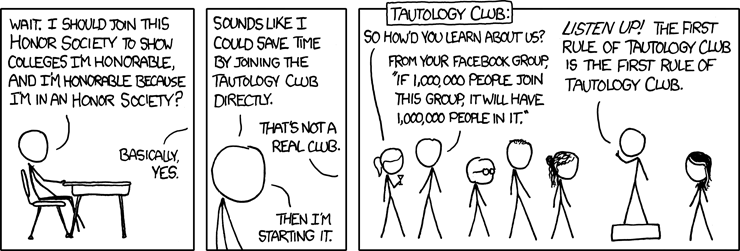
I am a member of that Facebook group and I read XKCD. (comic from Randall Munroe's XKCD #703)
"Men who attempt to attract women but do not succeed are losing out to other men. They are literally losers with respect to women. .... So, the candidate’s card is really a tautology: if you aren’t hooking up with the opposite sex, you are, in fact, a loser."
So, with one short comment, some random troll on the internet turned some idiotic fluff piece that annoyed me immensely and gave it an amusing and distracting skewering. I salute you, random troll. And yes, "random troll" is a tautology.
Monday, November 29, 2010
The TSA is Killing People
Okay, that's not exactly true...
But the TSA, with its new restrictions on travel, is causing more people to die.
This topic came up the other night during a seminar with my Economics advisor and a few other students. We were discussing the new TSA restrictions requiring either pat downs or scans before flights. There was a lot of debate on invasion of privacy versus the necessity of security, and the conversation had bogged down into an ideological stalemate.
That's when my professor piped up and said, "There's an Introductory Economics reason for why the new restrictions are a bad idea. Can anyone tell me what it is?"
After a few half-hearted attempts, one of the girls in the group asked, "Is it because it increases the marginal cost of flying?"
"That's half of it," our professor encouraged.
An awkward silence fell. Then one of the boys said excitedly, "It increases the number of cars on the road!"
"Exactly!"
Far more people die from car accidents per 100,000 people driving (it averages about 20 per year) than the number of people who die from planes per 100,000 people flying including all crashes, terrorist attacks, and random heart attacks from joining the mile high club (it's less than .1). That's 200 times the fatality rate. So, if the increased cost of being patted down or scanned encouraged 1 million more people each year to drive somewhere instead of flying, an additional 199 people would die.

Sure, the increased security may make it more difficult for terrorists to hijack or bomb planes, but considering the number of people who are killed on airlines by terrorists and the number of people who die in car accidents, it's not worth the lives of 200 people just to save 1. And that's how the TSA is killing people.
But the TSA, with its new restrictions on travel, is causing more people to die.
This topic came up the other night during a seminar with my Economics advisor and a few other students. We were discussing the new TSA restrictions requiring either pat downs or scans before flights. There was a lot of debate on invasion of privacy versus the necessity of security, and the conversation had bogged down into an ideological stalemate.
That's when my professor piped up and said, "There's an Introductory Economics reason for why the new restrictions are a bad idea. Can anyone tell me what it is?"
After a few half-hearted attempts, one of the girls in the group asked, "Is it because it increases the marginal cost of flying?"
"That's half of it," our professor encouraged.
An awkward silence fell. Then one of the boys said excitedly, "It increases the number of cars on the road!"
"Exactly!"
Far more people die from car accidents per 100,000 people driving (it averages about 20 per year) than the number of people who die from planes per 100,000 people flying including all crashes, terrorist attacks, and random heart attacks from joining the mile high club (it's less than .1). That's 200 times the fatality rate. So, if the increased cost of being patted down or scanned encouraged 1 million more people each year to drive somewhere instead of flying, an additional 199 people would die.

Sure, the increased security may make it more difficult for terrorists to hijack or bomb planes, but considering the number of people who are killed on airlines by terrorists and the number of people who die in car accidents, it's not worth the lives of 200 people just to save 1. And that's how the TSA is killing people.
Thursday, November 25, 2010
Paradox of Freedom
Ask nearly anyone and they'll tell you that more choices are better.
The more options you have, the more likely that the decision you make will match all of your preferences and be the optimal choice.
But that's not exactly true...
Imagine buying a car. If you're a consumer in, say 1912, there's really only one choice: the Model-T Ford. So, the decision is easy. You buy the car, and it's the best possible outcome.
Now imagine buying one today. There are dozens of options. After a few weeks of careful consideration and test driving, you find the perfect car: well priced, good gas mileage, looks nice, etc.
You buy it, you drive it off the lot, and get it home, and as you're admiring it in the driveway, you look over to your neighbors, the Joneses, and see that they have also bought a new car, and that Mr. Jones is likewise admiring his new car.
A brief conversation later, and you discover that not only did Mr. Jones buy a better car than you, but he got it for the same price.

As the buyer's remorse hits you, you realize that you did not make the best possible choice, but hey, no biggie, you still have a car that you like, right? And it sure is better than if your only available choice was the Toyota Camry (unless the car you bought was the Toyota Camry, in which case it is better than if your only available choice was the Ford F-150).
But let's say you're buying a car in a possible future fifty years from now. In this fantastical future, there no longer are car brands or standard vehicles. Instead, every single option is customizable, from the seats to the color to the layout on the inside to the way the body looks, you have never been more free.
You spend three months designing your perfect car on your computer, clicking and dragging everything you could possibly, getting rid of all the unnecessary accoutrements, like seat belts or the windshield, and the morning after you finalize your design, your dream car is delivered to your driveway. NICE.
You get in, begin the drive to work, and as you spill your piping hot morning cup of joe all over your shirt, you reflect on the fact that you had forgotten to include cup holders in your design.

Now, at this point, practically any car with cup holders and that could still drive would have been better. Not only has having unlimited freedom result in you choosing a car you don't particularly like, but it has resulted in you choosing a car that's even worse than the car you would have chosen if you had fewer options.
And here's what worse: you wasted all that time designing that car. In economic terms, think of the cost of the car in both time and money. Even if you had designed a car that was slightly better for you and slightly less expensive than a Camry, the Camry still would have been a better choice because it only took a week for you to choose the Camry and took months to design the other car. The increased opportunity cost of designing your own car outweighs the slight benefit of having a slightly better car. The irony is that having too much free choice can easily result in a less optimal situation.
The more options you have, the more likely that the decision you make will match all of your preferences and be the optimal choice.
But that's not exactly true...
Imagine buying a car. If you're a consumer in, say 1912, there's really only one choice: the Model-T Ford. So, the decision is easy. You buy the car, and it's the best possible outcome.
Now imagine buying one today. There are dozens of options. After a few weeks of careful consideration and test driving, you find the perfect car: well priced, good gas mileage, looks nice, etc.
You buy it, you drive it off the lot, and get it home, and as you're admiring it in the driveway, you look over to your neighbors, the Joneses, and see that they have also bought a new car, and that Mr. Jones is likewise admiring his new car.
A brief conversation later, and you discover that not only did Mr. Jones buy a better car than you, but he got it for the same price.

As the buyer's remorse hits you, you realize that you did not make the best possible choice, but hey, no biggie, you still have a car that you like, right? And it sure is better than if your only available choice was the Toyota Camry (unless the car you bought was the Toyota Camry, in which case it is better than if your only available choice was the Ford F-150).
But let's say you're buying a car in a possible future fifty years from now. In this fantastical future, there no longer are car brands or standard vehicles. Instead, every single option is customizable, from the seats to the color to the layout on the inside to the way the body looks, you have never been more free.
You spend three months designing your perfect car on your computer, clicking and dragging everything you could possibly, getting rid of all the unnecessary accoutrements, like seat belts or the windshield, and the morning after you finalize your design, your dream car is delivered to your driveway. NICE.
You get in, begin the drive to work, and as you spill your piping hot morning cup of joe all over your shirt, you reflect on the fact that you had forgotten to include cup holders in your design.

Now, at this point, practically any car with cup holders and that could still drive would have been better. Not only has having unlimited freedom result in you choosing a car you don't particularly like, but it has resulted in you choosing a car that's even worse than the car you would have chosen if you had fewer options.
And here's what worse: you wasted all that time designing that car. In economic terms, think of the cost of the car in both time and money. Even if you had designed a car that was slightly better for you and slightly less expensive than a Camry, the Camry still would have been a better choice because it only took a week for you to choose the Camry and took months to design the other car. The increased opportunity cost of designing your own car outweighs the slight benefit of having a slightly better car. The irony is that having too much free choice can easily result in a less optimal situation.
Subscribe to:
Posts (Atom)